
Identifying our most significant risks
Anchor Management Ltd. has a structured and systematic process of identifying and managing all material risks. Our risk management process aims to prevent or minimize the impact with regards to significant financial loss or negatively affecting our stakeholders or the economic life of the communities in which we operate. The risk management process takes into account the issues raised, their relevance, our stakeholders, and our governance framework.
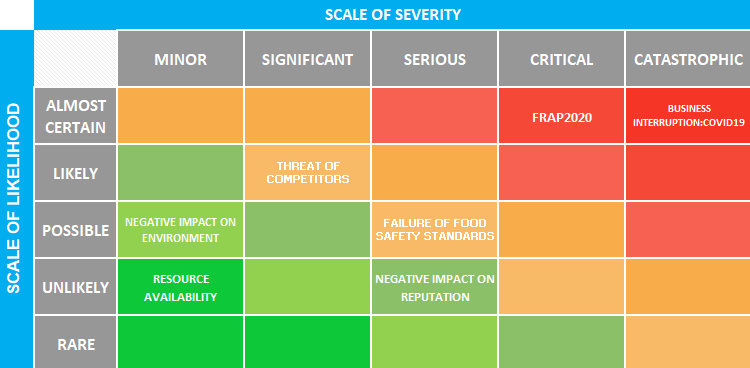
We have identified possible risks and analysed and assessed these risks in terms of their likelihood to occur and their potential impact. In doing so, we have identified actions and controls to mitigate the identified risks. The matrix diagram below shows the principle risks that were identified as well as its likelihood of occurrence and potential impact upon its occurrence.
RISK 1 BUSINESS INTERRUPTION DUE TO COVID19
RISK 2 FRAP2020: REALLOCATION OF FISHING RIGHTS
RISK 3 THREAT OF COMPETITORS USING NEW TECHNOLOGIES
RISK 4 FAILURE OF FOOD SAFETY STANDARDS
RISK 5 NEGATIVE IMPACT ON ENVIRONMENT
RISK 6 NEGATIVE IMPACT ON REPUTATION
RISK 7 RESOURCE AVAILABILITY
RISK ASSESSMENT MATRIX
RISK AND MITIGATIONS CONTINUED
RISK
RISK CONTEXT
MITIGATION ACTIONS
Business Interruption due to Covid19
Presently, Anchor Management Ltd. only sells to two companies who are both currently non-operating due to the Covid19 outbreak. This poses a severe (catastrophic) impact on the business and its operations. This non-operating activity will lead to loss of revenue and increased marginal costs reducing profitability.
Process and package our own anchovies. This increases the opportunity to do business with a more diverse customer base. Business Interruption Insurance. Create and set in place a complete Business Continuity Plan.
FRAP2020: REALLOCATION OF FISHING RIGHTS
Uncertain policies on the reallocation of fishing rights. Possible that the company might not have the right empowerment credentials to obtain these rights. Possible reduction of fishing rights allocated to a group
Multiple revenue streams. Attain a Level on B-BBE scorecard and black ownership credentials. Diversify workforce to promote social responsibility and inclusivity. Appoint a strategic team for FRAP2020
Threat of competitors using new technologies
Competitors accessing and making use of the latest technologies gives them a competitive advantage. Possibly affect revenue, profitability, shareholder dividends.
Adoption of information technology resources to maintain a competitive advantage. Regular maintenance of business’s IT systems. Technology Integration approach to increase business efficiency and productivity.
Failure of food safety standards
Concerns about quality of products. Customers are concerned about by-catch and there being by-catch in our products. Failure of food safety standards could result in product recall. Could negatively impact the brand and reputation of the company. Could cause harm to consumer.
Strict compliance with the highest food safety standards with regular checks by independent bodies. Monitor standards and regulations. Establishment of a compliance team. Pursuing testing and certification.
Negative Impact on environment
Stakeholders are concerned about the business’s activities negatively impacting the environment (in which we operate) as well as marine life. If so, could possibly reduce the business’s customer base; lack of support from stakeholders.
Work towards maintaining an Eco-friendly business. Conduct sustainability audits. Adopt new technologies and materials that are more sustainable and Eco-friendly. Become eligible for Marine Stewardship Council (MSC) certification which would show the company’s commitment to sustainability.
Negative Impact on reputation
Due to increased use of technology, the exposure to cyber attacks is inherent. Business’s brand/reputation could be influenced by negative social media campaigns.
Maintain MSC certification. Strict monitoring of social media platforms. Constantly seek feedback from customers. Outline a crisis management plan.
Resource Availability
Concerns about the depletion and collapse of major fish stocks. Could result in non-operation of the business. Climate changes resulting in changes in ecosystems, affecting ability to harvest
Comply with regulations and responsible fishing practices. Diversification into aquaculture. Invest in resource management software.
 Anchor Management Ltd.